contributed by Brian Knauerhase
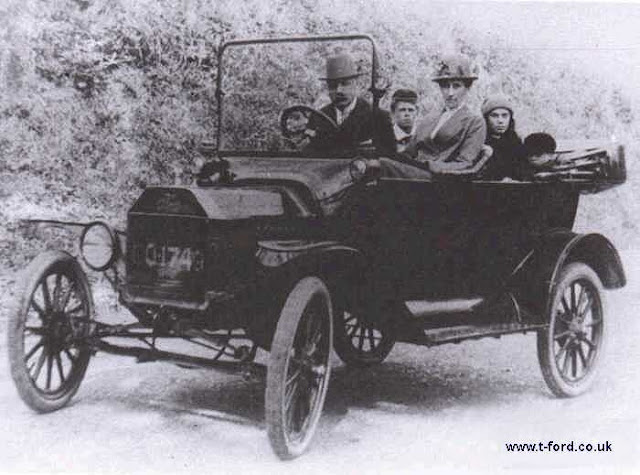 |
| Model T Ford Register of Great Britain, c1916 Ford Tourer [online, accessed 9 June 2003], used with permission |
How to Drive a Model T Ford
I know one or two of you may be familiar with the workings of the car, but a bold approach is called for if you are to drive one.
On opening the driver's door you will be confronted by the hand brake lever, so you must either let it right off and climb over the top, or leave it in the up position where it will scrape the underside of your knees.
Taking a quick look around you will notice that there is no foot throttle or gear stick, no oil gauge or any other instruments unless perhaps an after-market Corbin or Stewart speedo (driven by a gear on the front wheel) has been fitted. You will see a black box on the dash with a key on a chain. This is reverently referred to as the buzzer box, and emits sweet sounds as the engine is cranked. Note also there are 3 foot pedals. Don't be deterred, their operation is simple and the driver proceeds as follows - Check the hand brake. If it's right back the brake is applied. Pushing it halfway forward will disengage the clutch. Pushing it right forward will put it into top gear.
Try the left foot pedal. It is automatically in top gear unless you press it halfway down when the car will be in neutral provided the brake lever is either in neutral or high. Press it all the way down and you will have low. There are only two gears. That's what makes it so simple. The right pedal of course is the foot brake, which only leaves the spare one in the middle.
Providing you have the left pedal half way down, or the hand brake half way up, then depressing it will put the car in reverse. If you follow the above procedure you can happily go from top to reverse. The car doesn't seem to mind, and wont drop a heap of gear to the ground, as once did my friend's Holden ute.
Starting the engine is also very simple. Raise the bonnet and look around. Notice there is no water pump, no thermostat, no self-starter, no dipstick, no air cleaner, no distributor, although there is a curious thing called a timer. This is probably the most vital part of the engine. It is controlled by one of the levers you may have noticed just below the steering wheel.
It is absolutely vital that the timer lever be precisely in the correct position before cranking the engine. Failure to do so will result in a backfire and probably a broken arm. I have never had a broken arm, but two of my friends have.
Old time doctors said they could always tell a broken arm caused by a Model 'T'. It was always the right arm, broken in two places due to the time it took to pull the arm away from the furiously spinning crank handle.
The starting procedure is as follows - Check that the hand brake is on - right on. Failure to do so will mean you will be run over by your own car after it starts. Insert the key that dangles at the end of the chain into the buzzer box and turn to BAT (short for the 6 volt batteries used for starting). Set the throttle lever down a bit, set the timer lever, and engage the crank handle. As you turn the engine listen for the notes coming from the buzzers. No buzz - no go.
As the engine roars into life it will make loud knocking noises. Don't be alarmed, it is meant to knock. Quickly turn the key to MAG (short for magneto). It loves it and will run much better on MAG.
Now take the car for a drive around the yard or paddock to become familiar with it, but don't go onto the road just yet. There is more to learn, so next we will discuss some of the driving techniques and maintenance issues.
Preparing the Model T for the Road
Assuming that you are now familiar with the workings of the car, the time has come to prepare it for the road.
It is wise to first check the oil level. This is done by lying on your back and sliding under the car. At the rear of the transmission on the left-hand side you will find two brass drain cocks. Open the top one. If oil comes out you have plenty. If it doesn't, you still have the other one, so try that. If oil then comes out you are OK, but watch it. If no oil emerges then oil must be added until it drips out the top tap. Oil is added through a cap at the front of the engine, and this is accessed by raising the right hand side bonnet. The easy way is to have someone under the car ready to close the taps and report to the person pouring. If you are alone it may take a bit of to-ing and fro-ing to get it right.
You will almost certainly have to add water to the radiator, not because it leaks, ('T' radiators are practically indestructible - many giving sterling service after 30 years of use and abuse), but because all model 'T's boil.
Petrol should be checked now. Do you have enough? To find out, remove the front seat completely. This is easy enough, unless the wife is comfortably ensconced on it with the usual shopping bags, rugs, thermos flasks and other paraphernalia wives tend to gather. Clear it all out onto the ground. Unscrew the cap on the top of the tank. Experienced drivers will have a piece of wire to dip into the tank to find the level of the petrol. Rusty wire is best, otherwise a stick or whatever comes to hand will do. The best way to fill it used to be to place a can of petrol over the hole, and drive a long spike through it from top to bottom. When the drawn petrol flowed copiously it could be controlled by partially replacing the spike. Unused petrol was stored by placing the tin on its side with the spike inserted. Of course there were other patent gadgets with clamps and spouts and things, but to me the spike seems the simplest.
The spike and wire and other items like the jack, tyre pump vulcaniser (all essential equipment), together with the Ford's meagre tools are kept under the back seat. Because there is no boot or luggage carrier the back seat is where everything, including the kids, are kept. You do not like taking out the back seat more often than is absolutely necessary.
If nighttime driving is anticipated you should be ready for it, so clean out the carbide container and refill with new carbide, and also refill the small container above it with clean water. It is a messy system, but gives an exceptionally good light. If your car is a modern version, it could be fitted with electric lights. Electric lights only require a flick of a switch, but this conversion is offset by the fact that it gives off good light only at full engine revs, but drops of alarmingly as you slow down. When opening gates etc. the throttle should be kept open to give enough light to see by.
I won't mention tyres, I hate tyres. Just keep the pressure at about 50 PSI and hope they stay up.
Greasing is done by a myriad of grease cups, which, because they are so small, need constant refilling. They should be screwed down a little, before the affected part begins to squeak or rattle.
Now the car is ready. You are ready. Hop in and enjoy some trouble free motoring. Oh! I forgot. Just check the steering wheel hub housing. It screws off easily and kids love to remove the steering wheel and look in at the epicycle cogs, contained there-in, and usually they end up with black greasy fingers. If not tightly closed it can and often did undo - unnoticed - leaving the driver with a wheel in his hands and small gears on the floor. A bit disconcerting, especially in a busy street.
The Advanced Driver Training Course
Firstly let me apologise to any Ford owners who thought I'd implied that 'T' radiators only lasted 30 years. Gremlins must have crept into the system. Some radiators are still giving sterling service after 90 years of use and abuse.
Now for the driving tips, - or as they say, the Advanced Driver Training Course.
We will start with hills. Most driving problems arise from hills. Remember the petrol tank is in the chassis at approximately the same level as the carburetor. Thus prolonged steep upward travel means little or no petrol gets into the carby, causing the car to splutter then stop. The answer is to point the nose down hill (plenty petrol), and proceed upward in reverse. The car also has lower gearing in reverse, hence more driving power.
Another important aspect is that the engine is oiled by what is known as the splash system. The flywheel flings oil to all parts of the engine, and this works fine on the level, but uphill the oil runs to the back of the transmission housing, and the front of the engine misses out. All the more reason for reversing uphill.
Of course the opposite happens downhill. I remember once going from Wilmington to Port Augusta through Horrocks Pass, before the so-called new road was put in. She flew down the hill to the bottom, then spluttered and stopped. Fortunately I had a spare set of plugs, (always keep a spare set of plugs), and while my passengers stretched their legs, the plugs were changed. Of course, if I didn't have any spare ones, all would not be lost as a bit of wire or string could have been attached to the plugs and then each could have been dunked into the petrol tank to remove the oil. Incidentally the car went up the Pass in top gear on the return, only stalling at the top bend with the summit in sight. Try that in your modern car and see how far you get. Of course I did the decent thing at the top of the climb and gave her a rest, and a bit of time for the radiator to settle down.
Wet weather: In normal circumstances the hood was back. It had less wind drag that way. It looked racier and the stiff breeze was said to be beneficial to health. The hood was really only meant to be put up if rain threatened. I wont go into the full procedure of raising the hood, removing the side curtains from their pouch and pinning them in position, checking that the kids hadn't put their feet through the celluloid windows etc.
Because the roads were either all bull dust when dry, or all mud if wet, the car was equipped with a windscreen, which was effective at keeping mud out, but unfortunately this impaired the driver's vision somewhat. Henry had foreseen this and so provided the car with a split windscreen that could be opened louvre fashion to provide a slit to see through. This safety feature had dubious value, as it then let the rain blow in. Still, with horse and buggy you got wet, so this was very little different. Hand cranked windscreen wipers were sometimes fitted, as were many other gadgets and things to make motoring easier. One manufacturer even designed a big lever arrangement which could be used by the driver instead of having to get out and crank the engine, - very useful in the wet.
My personal favourite was an exhaust cut-out - now illegal. Operated by a small lever on the floor, it enabled exhaust gasses to be passed directly out into the atmosphere instead of first going through the muffler. Definitely not to be used past hospitals and old folks' homes, it was said to give more power - it certainly sounded more powerful. I think I used the cut-out to good effect when climbing Horrocks Pass.
I nearly forgot. Check the bands. All 'T' owners know about bands. All 'T' owners regularly check their bands. If you remove the cover plate on top of the transmission by undoing a couple of screws, you can look in and see the adjustments attached to the said bands. If it is too tight it will produce what is known as a sticking band, and the car will want to go forwards or back, depending on what band is sticking. Sticking bands also make cranking harder and reduce power. Avoid having sticking bands. Slipping bands are probably worse. The car will not want to go properly with slipping bands, and will slow down when the going gets hard. So always make sure the bands are adjusted correctly.
Here is a handy hint - On long journeys or in the outback, always wear a leather belt. The flat fan belt sometimes breaks or comes off and is lost. You can then use your belt as a temporary replacement. Cut the surplus off, but don't discard it. A piece of leather belt makes a good bearing substitute if lack of oil causes a big end to knock out or run. In more serious cases, say a bent conrod or damaged piston, just remove the offending items and proceed on three cylinders. It hardly makes any difference as you are often only on three cylinders anyway. (Joke!)
Almost any part can be removed or repair undertaken on the side of the road, using simple tools. The car was made that way.
In closing, here is a party trick. Collect a good audience, then crank the engine furiously. It refuses to start. Swear at it, then give the front tyre a kick as hard as you can. The car instantly roars into life, much to the astonishment of bystanders.
The secret - it was switched off during cranking, which filled the cylinders with a rich petrol mixture. As you kicked the tyre an accomplice switched it back in and slightly shifted the timing lever until it buzzed, starting the car.
I have done a variation of this many times and it never ceases to amaze.
You may have guessed by now - I love Model 'T' Fords.
Some Ford History
Recently Holden proudly celebrated the production of their six millionth vehicle. Forget it! Henry made over 15 million of just one model! At the peak of production Ford turned out a car every ten seconds. That's right - ten seconds, no misprint. In 1923 for example, Ford produced 2,055,309 cars. Trains had run to extremely strict time-tables to prevent disastrous log jambs. Equal amounts of supplies also needed to be shipped in.
Henry of course was the founder of mass production, you say. Wrong! That honour goes to Ransome Eli Olds and his Oldsmobile. He did however introduce that moving assembly line and that is what made such huge outputs possible. The price of a Ford car as a consequence came down from £1,200 to £295, enabling the average worker to be able to afford one. In 1914 when factory workers were getting a little over £2 a day, Ford announced a minimum wage of £5 a day and cut working hours to eight a day. The opposition said it would bankrupt him, but his workers only made more than ever.
Ford cars had no frills. They just had the basic essentials. As a result, accessory manufacturers had a field day. They offered an array of extras to tempt every type of discerning owner. Farmers could attach a belt pulley to the rear wheel, and after jacking up that wheel, cut chaff, saw wood, or try any of a dozen applications. If that were not enough, the wheels could be removed completely and the fixing of a kit conveniently converted the car into a tractor in no time at all.
Among the 5,000 or so accessories available are listed such items as carbon eaters at $1.95, sight glass oilers for n. 1 cylinder, exhaust operated fog horns, and exhaust cut-out complete with cable and pulleys for only 38 cents. There were anti-rattling gadgets by the dozen, which could be attached all over the place; road smoothers and shock absorbers were always popular. For added convenience you could fit various spare tyre and equipment holders, and safety clamps on bumpers. Starting devices could be cable or lever operated, some with anti kick back features.
A steering pilot locked the wheels in the straight-ahead position allowing 'hands off' driving. Why would you want 'hands off' driving? Sounds suspicious to me (and dangerous). A gasoline-fired vulcaniser might be just the thing for Dad's birthday. Times must have been much as they are now, because dozens of anti-theft locks and devices were for sale. One even had a bar which lifted the back wheel off the ground if the car was driven forward. Imagine the thief's surprise!
Special roadster and speedster bodies were being manufactured to add some prestige or advantage to 'T' owners. These often included engine modifications such as overhead valve gear, water and oil pumps, and improved carbys.
Cars were shipped to Australia in knocked down form and during the war years when shipping was at premium, bodies were made locally to save space. In South Australia Duncan and Frazer made most of the bodies and we were spared the 'any colour so long as it is black' syndrome, although the chassis and fenders which were imported were of course always black. Duncan's painted the bodies a variety of colours. Other states had their own body providers and differed accordingly. British Empire customers had their cars not made in Detroit, but just across the border in Canada. The rationale behind this was that there were no duties payable between Empire countries.
These articles are in now way intended to give more than the briefest insights into the world of the 'T'. Many books have been written on the subject and I recommend their reading for added interest.
Knauerhase, B. 2001, 'Henry's Wonderful Model 'T' Ford', Bordertown Vehicle Restorers Club Newsletter, (ed. Kathy Creaser), No. 81, 82, 83 & 84.


 Although everyone got wet, the day was enjoyed by all - and the
spectators were given plenty to look at. There were a record number of
entrants, some coming from Adelaide, Jabuck, Naracoorte, Padthaway,
Coonalpyn, and visitors from Horsham and Portland. Trophies were
presented to the various class winners. The Lions Club did a marvellous
job with the catering, and thanks to all other helpers.
Although everyone got wet, the day was enjoyed by all - and the
spectators were given plenty to look at. There were a record number of
entrants, some coming from Adelaide, Jabuck, Naracoorte, Padthaway,
Coonalpyn, and visitors from Horsham and Portland. Trophies were
presented to the various class winners. The Lions Club did a marvellous
job with the catering, and thanks to all other helpers.


